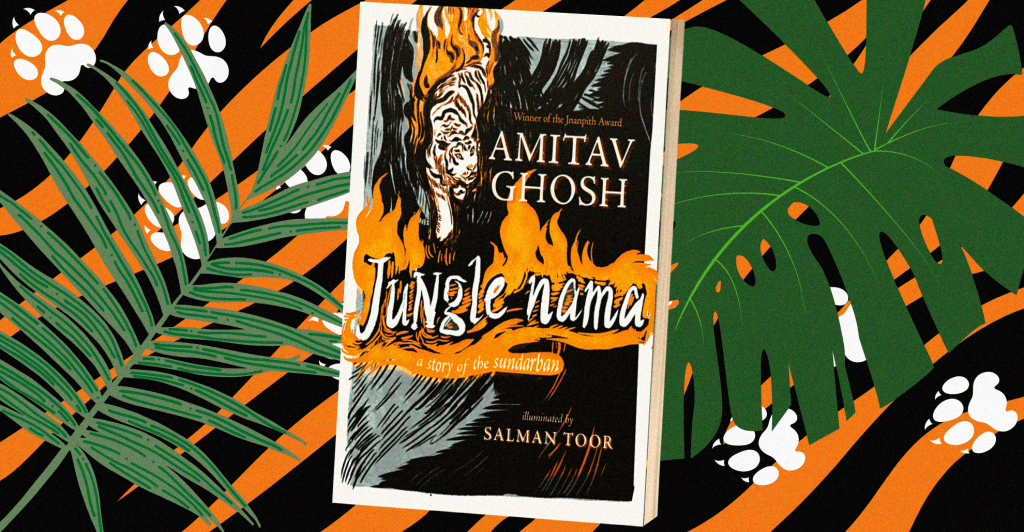
Jungle Nama is Amitav Ghosh’s another attempt to tackle the wisdom and evoke the wonders of the folk mythology from the Sundarbans, as he did before in his socially awakening novel The Hungry Tide (2004). The author’s first-ever book in verse is a free-adaptation of a cultic folk narrative of the Bon Bibi Johuranama, dating as far as to the 19th-century print versions, composed in a Bengali verse meter known as dwipodi poyar.
It is the story of the wealthy merchant Dhona, the poor lad Dukhey, and his mother, the terrifying spirit of Dokkhin Rai, who appears to humans as a tiger, Bon Bibi, the goddess of the forest, and her warrior brother Shah Jongoli. Amitav Ghosh takes a fantastical folk tale, which might seem like a nursery rhymes, and transforms it into an epic manifesto on the capitalistic and ecological discourse, continuing his thoughts from The Great Derangement: Climate Change and the Unthinkable (2016). In a way, he reminds us why folk tales of the Sundarbans are undeniably timeless.
This is also a powerful collaboration with a young generation of artists — Salman Toor, who “illuminated” Jungle Nama with the stunning artwork, and Ali Sethi, known for his “multicultural non-binary musicality”, who narrated an audio version of the story — to move the narrative from a solitary fiction read into a community-based transmedial phenomenon.
ALISA KITRAR: This is the first time that your book was written in verse. What do you remember about the moment when the idea came up in your mind, and if the outcome resembled what you thought it would be?
AMITAV GHOSH: A lot of time ago, I wrote The Hungry Tide, published in Italian as Il Paese delle Maree. This legend figures in that book quite a lot, so while I was writing that book, I actually stopped translating, maybe just very roughly. I had those notebooks; I kept thinking about them and coming back to them. And at some point, I wrote another book called The Great Derangement. In that book, I talked about the importance of finding other ways and forms of communicating with readers and audiences. So it seemed like a natural thing to come back to some other way of writing. And that is what has brought me back to the legend — it was a work I had begun and somehow not finished.
“The best way to address the climate crisis, in my view, is by accepting certain constraints: what we consume, how much we buy — all of that”
— Amitav Ghosh
AK: In the story of the Sundarbans, ‘the magic of meter’ saves lives and brings peace to the characters. One moment that drew my attention is when Ma Bon Bibi tells Dokkhin Rai to think in verse to calm down, and he finds that very helpful in the future. Why have you chosen to write in verse in your own work, and do you think using this form is the best way to address the planetary crisis problem?
AG: You know, the telling of this story is in Bengali. There are two Bengali texts of the story, and both of those ones are in verse. I think stories like these are told in verse because verse adds something to the story, and it also takes us to a different place, other spaces where we can think differently. The fact that the word ‘prosaic’ comes from the word ‘prose’ is not accidental. So when we write in prose, we are automatically writing something prosaic. But when you write in verse, you can create a sense of possibility; poetry in itself carries the narrative forward and adds a particular dynamic. It really just brings momentum to a story. When you look at all the verse stories, constantly adapted into prose, I think prose takes something away from the story. And here, there was also the idea of constraint that was very much fundamental to the story. The best way to address the climate crisis, in my view, is by accepting certain constraints: what we consume, how much we buy — all of that. In fact, the verse is a form of constraint too. When you write in verse, strictly counting your syllables and rhymes, it means that you are dealing with a very constrained form of language. But again, we are accustomed to thinking that constraint is negative, that it takes something away, whereas constraint can also be very positive. It can produce beautiful things as well. Indeed, this has always been the case with verse; writing under certain constraints actually creates its own kind of richness.
AK: While reading your story, I thought that Dokkhin Rai and Dhona represented human nature and human greed. But at the end of the story, Ma Bon Bibi pledges forgiveness for Dhona, also making Dokkhin Rai a Dukhey’s friend. So I was curious why Dhona is not punished somehow, and whether it is a way of saying that some traits of human nature should be forgiven and understood rather than punished for?
AG: I think that is open to interpretation; you can have your own understanding of it. But in a sense, Dhona is punished because he is being exposed as someone who has done bad things, and he has to confront Dukhey, who becomes a powerful figure in his own right. There is a specific punishment on both of them, including Dokkhin Rai. He is reminded of the limits that he has to deal with. So, the whole idea of the story is just one of facing limits and a reminder that there can be greed on both sides. There can be human greed, but also Dokkhin Rai becomes greedy. However, Dokkhin Rai as the tiger also defends the purity of the forest.
AK: Let’s jump away to another matter that you have recently raised as a climate activist. Climate change, as you say, is violence, and it is a war perpetrated by geopolitics, as there can be no ethical consumption under capitalism. It is an injury to our morals that builds up over time, like the climate crisis, and creates despair. Can art and narrative, such as Jungle Nama, be a bridge to a balance between our morals and environmental needs?
AG: I hope that it is the case. I mean that it can create some sense of how you relate to people and to the Earth. The violence against the environment has really begun with the violence against other human beings. When slavery started in the 16th-17th centuries, people came to be treated as objects, literally exploited and slaved. That was this connection that caused the same conceptions to have emerged concerning nature and the Earth. If we are going to change how we relate ourselves to the Earth, we also have to change how we relate to other human beings.
AK: In this case, do you know any other fiction — prose or poetry — highlighting the climate crisis, and if yes, have you been influenced by such ones?
AG: There is a lot of poetry, prose, and other art on these themes, such as extinction rebellion. A group called Writers Rebel has also been very productive in these kinds of artwork. And I think it will be growing more and more. Every day I see on my website someone sending me a story or a poem. I appreciate the fact that reading my books has sensitized people into thinking of the climate crisis. And I am sure, as we go forward, it seems very clear that things will get dramatically worse. I hate to tell you, but this COP26 has not made any difference whatsoever, and in fact, this year, global greenhouse gas emission has risen faster than ever before. 2019 and 2020 were record years for greenhouse gas emission numbers. There were many people in 2020 thinking that the Covid pandemic is going to change our daily patterns, but anyone who studied the epidemics is going to tell you that after epidemics, people usually go back to their old habits with a vengeance. And it seems to be the case now. I don’t know if you have been following what has been happening in Canada. This summer, there were record-breaking heat waves in British Columbia, quite a cool-tempered region around Vancouver. They completely dried out and killed all of the vegetation. And now, suddenly, there is a rainfall record, and Vancouver is wholly cut off from the rest of Canada, highways are broken, people are left out. It is astonishing.
AK: Thank you for a profound discussion. I was always wondering that writers might usually think of what kind of a reader will read their books, and maybe they even frame their stories based on this idea. So, what kind of a reader did you have in your mind, writing the Jungle Nama story? Honestly, I had to do external research on some cultural patterns, myths, and legends to better grasp the story.
AG: It‘s pretty common for people to think that writers have particular readers in mind, and I think that may have been the case when a writer was writing, say, only for Italians. But for someone like me, my readership is so spread out — it‘s in India, Europe, Indonesia, China, and North America, so I cannot imagine who my reader is. I really don’t write anything thinking, “Oh, well, that’s the reader for whom this is intended.” I don’t think it is intended primarily for children, young people, or anything like that. Of course, when I was writing Jungle Nama, I hoped that it would reach many people.
Amitav Ghosh’s Jungle Nama (HarperCollins, 2021) is available for purchase on Amazon from February 1, 2021.


 POSTMODERN PROMETHEUS
You must be logged in to post a comment.