
After its release in 1976, “Taxi Driver” became an instant classic and has since been regarded as one of the greatest American films ever made. Directed by Martin Scorsese and written by Paul Schrader, the movie stars Robert De Niro as Travis Bickle, a Vietnam War veteran who becomes a taxi driver in New York City. Bickle is a lonely and isolated figure who descends into madness as he becomes increasingly disillusioned with the society around him.
The movie was initially met with mixed reviews and controversy due to its violent and graphic content. However, it went on to receive four Academy Award nominations, including Best Picture, Best Supporting Actress for Jodie Foster (when she starred in the movie, she was just 12 years old!), and Best Original Score for Bernard Herrmann, who tragically died the night after he finished recording the film’s score.
The film’s exploration of loneliness, alienation, and urban decay struck a chord with audiences, especially in the wake of the Watergate scandal and the end of the Vietnam War. “Taxi Driver” was seen as a reflection of the disaffected youth of the 1970s and a commentary on the state of American society.
Aside from its cultural impact, “Taxi Driver” is also notable for its visual style and cinematography. The movie’s depiction of New York City’s seedy underbelly and its use of color and light have inspired countless filmmakers over the years. Scorsese’s collaboration with cinematographer Michael Chapman resulted in a visually stunning film that still holds up today.
In recent years, “Taxi Driver” has been reevaluated and analyzed by film scholars and critics, who have praised its exploration of masculinity, violence, and mental illness. The movie remains a touchstone for filmmakers and a masterpiece of American cinema.
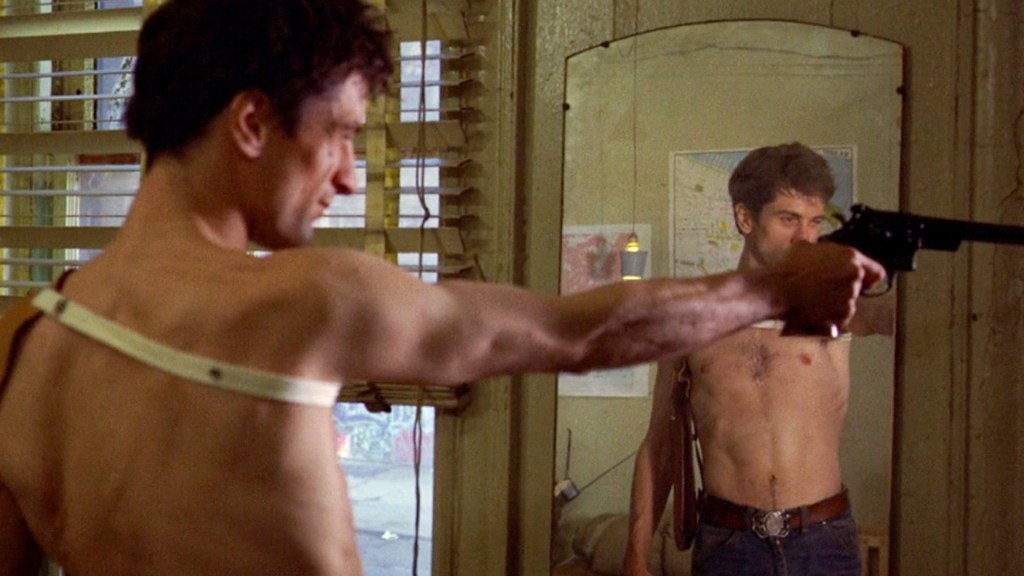
One of the most iconic scenes in “Taxi Driver” is when Travis Bickle stands in front of a mirror and rehearses the line, “You talkin’ to me?” The line has been quoted, parodied, and referenced countless times since the film’s release, but few people know the story behind its creation.
According to Paul Schrader, the screenwriter of “Taxi Driver,” the line was not in the script. We found a source that reviewed all of his drafts from 1974 to 1976 and confirmed that the scene did not originally include the famous line. Instead, it was a pure improvisation by De Niro. The scene looked like the photo copy from the shooting script belonging to Robert De Niro. There are also his notes, which allow us to peek into his acting process. De Niro’s approach for creating the scene was meticulous. He highlighted all the mentions of his character in red ink and translated the dialogue into physical actions, connecting his character’s motivations and goals with his movements. For example, he wrote “shooting aimlessly“, “here I change my gun“, “here I reach out my hand and draw my gun” in the margins of the script.
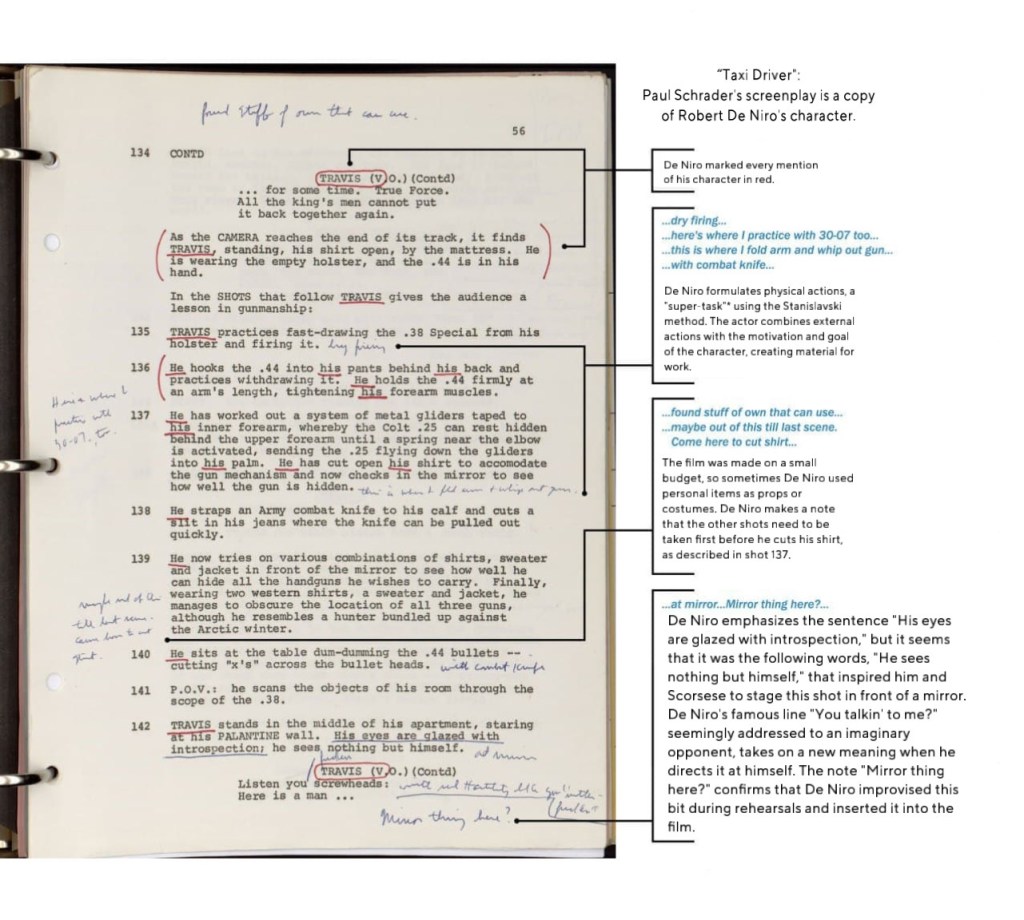
Another interesting detail was that the script did not specify a mirror in the scene. However, De Niro proposed using a mirror to reflect his character’s gaze back onto himself. In doing so, he transformed the line from a counteract to an inner monologue, directed at himself rather than an imaginary opponent — and during the rehearsal, the famous improvisation was born: “You talkin’ to me?“
De Niro’s inspiration for the line came from an unlikely source: a Bruce Springsteen concert. In 1975, De Niro attended Boss’ concert, which started with this phrase as a set-up — the audience shouts “Bru-u-u-uce!” at him, and he replies from the stage: “Are you talking to me?” The line was intended to rile up the crowd, and De Niro took note of its effectiveness.
The actor later told saxophonist Clarence Clemons, who played with Springsteen, about the line and began incorporating it into his own performances. When it came time to film the scene in “Taxi Driver,” De Niro felt the line fit perfectly with his character’s psychological state.
The improvisation was a risk, but it paid off. De Niro’s delivery of the line is confident and chilling, capturing his character’s descent into madness. The line became an instant classic, and De Niro’s performance in “Taxi Driver” evidently earned him an Academy Award nomination for Best Actor.
The story behind “You talkin’ to me?” is a testament to the power of improvisation and the creative process. It shows how a seemingly random idea can turn into a moment of cinematic history. The line has become a symbol of De Niro’s talent as an actor and the enduring influence of “Taxi Driver” on popular culture. “You talkin’ to me?” is more than just a line – it’s a cultural touchstone that has stood the test of time.
* The Stanislavsky Method is a popular approach to acting that emphasizes the use of personal experiences and emotions to create a realistic portrayal of a character. One of the key elements of this method is the “super task,” which refers to the main objective or goal that a character is trying to achieve throughout a scene or play. To begin exploring the super task, an actor must first thoroughly analyze the script and identify the underlying motivations of their character. This involves looking beyond the surface level of the dialogue and understanding the character’s backstory, relationships, and overall arc within the story. Once the actor has a clear understanding of the character’s motivations, they can then identify the super task that drives their actions in each scene. The super task is usually a broad, overarching goal that the character is working towards, such as achieving fame, finding love, or seeking revenge. As the actor rehearses and performs the scene, they must keep the super task in mind and use it to guide their choices and actions. This can involve breaking down the scene into smaller “beats,” or moments where the character makes progress towards their super task. For example, in a scene where a character is trying to win back the love of their ex-partner, their super task might be to prove that they have changed and are worthy of a second chance. Each beat of the scene could then be focused on achieving this super task, such as making a heartfelt apology, recounting the ways in which they have grown, or showcasing their commitment to the relationship. By using the super task as a guide, actors are able to create a more nuanced and layered portrayal of their character. This approach allows them to tap into their own emotions and experiences, which can bring greater authenticity and depth to their performance.

Sign up for our freshly baked posts
Get the latest culture, movie, and urban life updates sent to your inbox.
Subscribe
Join a bunch of happy subscribers!
 POSTMODERN PROMETHEUS
You must be logged in to post a comment.