Defenestration: a word as peculiar as the act it describes — throwing something or someone out of a window. This term isn’t just about a dramatic exit; it holds a haunting grip on the annals of history.
Graffiti by street artist STRØK in Paris, France
Take 17th-century Prague, where the defenestration of Catholic officials ignited the spark for the devastating Thirty Years’ War. The story does not merely end with shattered glass and plummeting bodies; it highlights a violent collision of political and religious tensions that had been simmering beneath the surface. Before this, the First Defenestration of Prague in 1419 had already cemented the term in historical memory. Beyond Europe, instances of defenestration can be traced to various cultural contexts. In ancient Rome, for example, defenestration was sometimes used as a form of execution or public humiliation.
Defenestration in pop-Culture
Fast forward to modern crime dramas, where defenestration serves as a shocking plot twist, this word seems timeless. Think of Hitchcock’s film “Vertigo,” where heights and falling play central roles. Starting from the 1940s, noir films often employed defenestration as a narrative device that signifies the protagonist’s ultimate despair or the villain’s final undoing. Recent TV series, ranging from “Game of Thrones” to “Breaking Bad“, have also employed defenestration as a heart-wrecking plot device that contributes to a story’s suspense and emotional weight. In literature, defenestration features in Dostoevsky’s writings as a symbol of turmoil or turns up in works like Albert Camus’ “The Fall,” serving as a metaphor for existential free fall. Even in pop culture, comic book heroes like Batman or Spiderman regularly defenestrate villains as a go-to move.
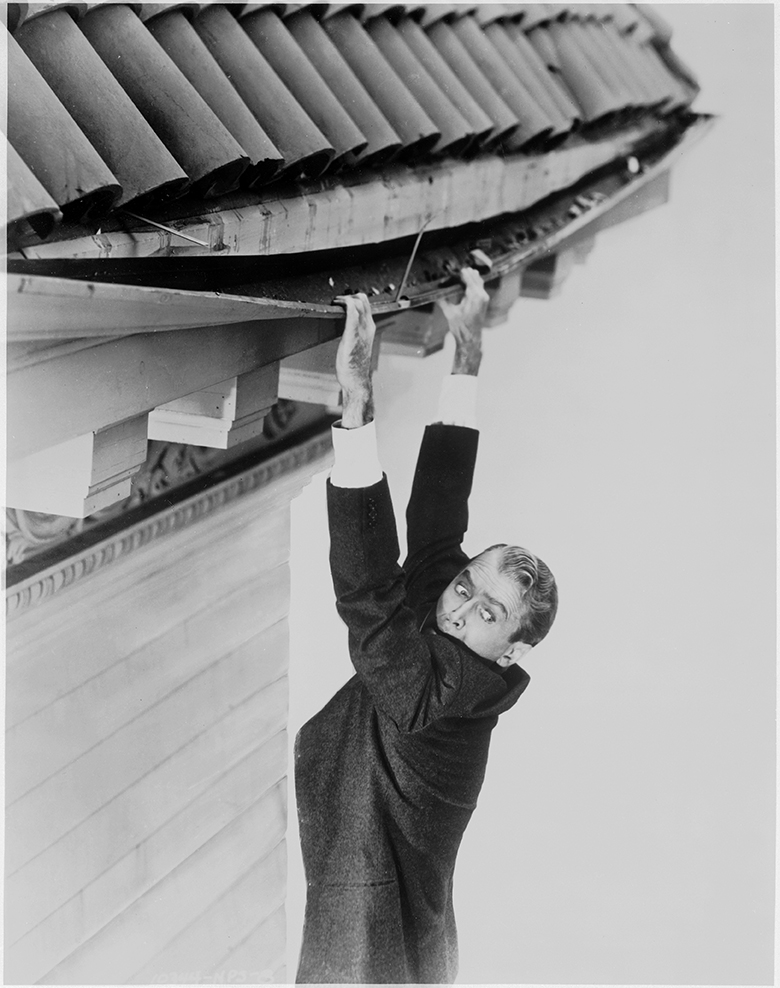
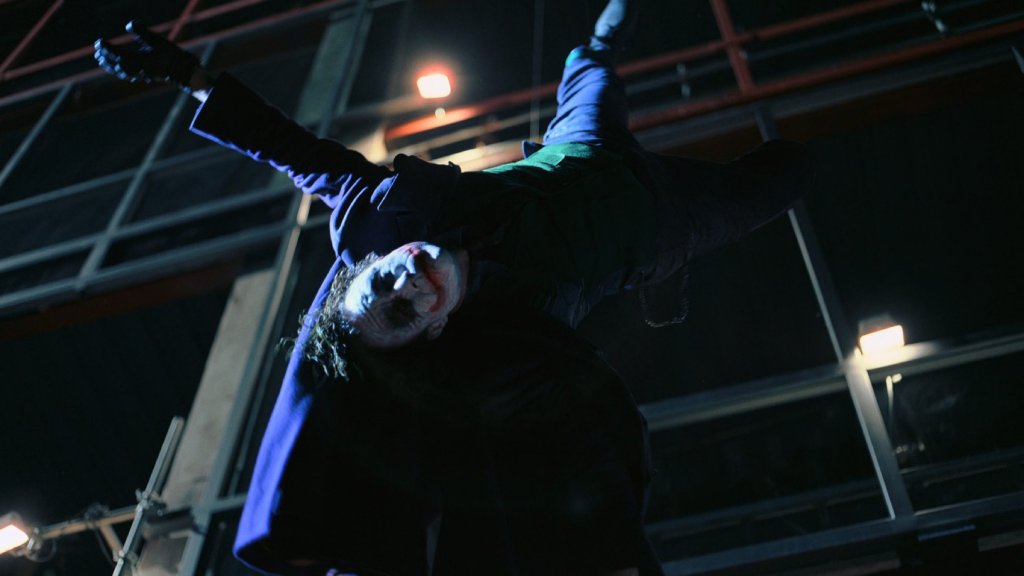
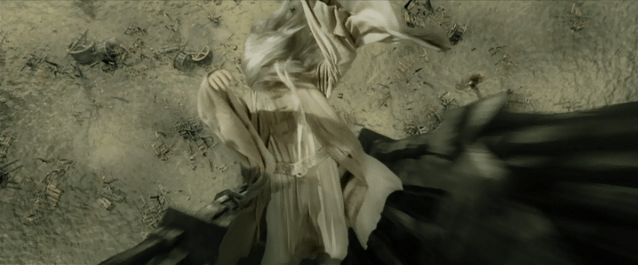
From the perspective of our magazine’s evocative series, “The Dark Side of the City,” we plunge into ‘defenestration,’ not just as a word, but as a narrative echo. Think of it as the urban embodiment of a sudden turn of events — much like the financial crashes that shake Wall Street or the spontaneous protests that ignite change. It’s calculated yet reckless, weaving itself into the very fabric of our cities.
Defenestration as Art exhibit
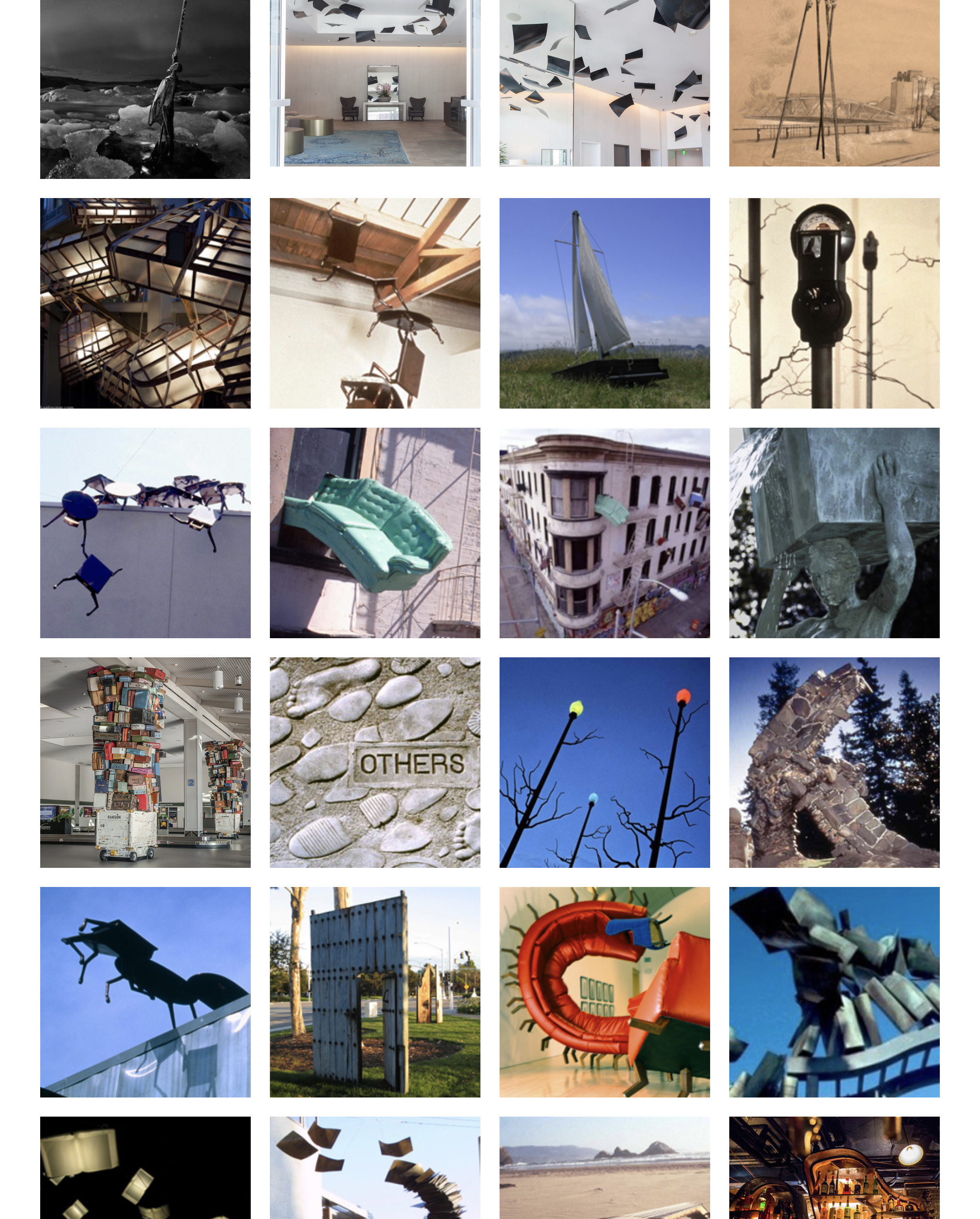
Adding to its multifaceted tale, consider the Hugo Hotel at Sixth and Howard Streets in San Francisco. For 17 years, it stood as a canvas for an iconic art installation that captivated the city’s imagination. Named “Defenestration,” the work by artist Brian Goggin featured furniture — tables, chairs, and even a precarious bathtub — appearing to leap from the building’s windows. Initially planned as a six-month exhibit in 1997, it evolved into a local landmark and tourist attraction. “Escaping” from the abandoned tenement building, located in a neighborhood often unfairly labeled as “skid row,” the furniture — cast-off, forgotten — became a poignant reflection of the community’s marginalized residents. “I feel like I’ve been a custodian for many years,” Goggin said.
Adding another layer to this complex narrative, Goggin shares an epiphany that occurred while working on an installation in Paris. Observing the demolition of an 18th-century apartment building, he said, “As they removed the majority of the building, they left the side walls, and you could see wood paneling, tile remnants of staircases… all just insinuating this life that was no longer in a physical form.” At that moment, he envisioned the furniture “crawling like ants trying to escape a destroyed anthill,” a vision that catalyzed his iconic San Francisco work.
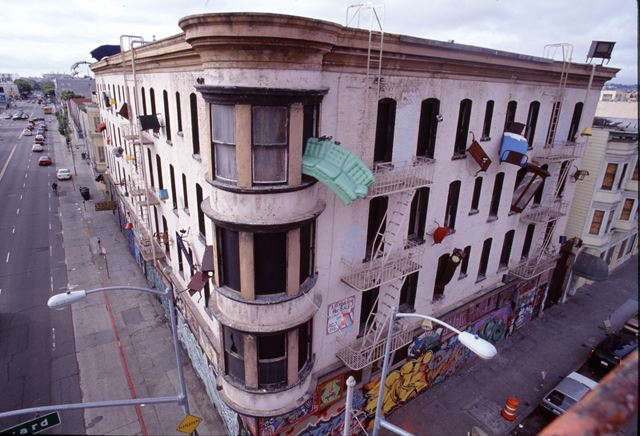
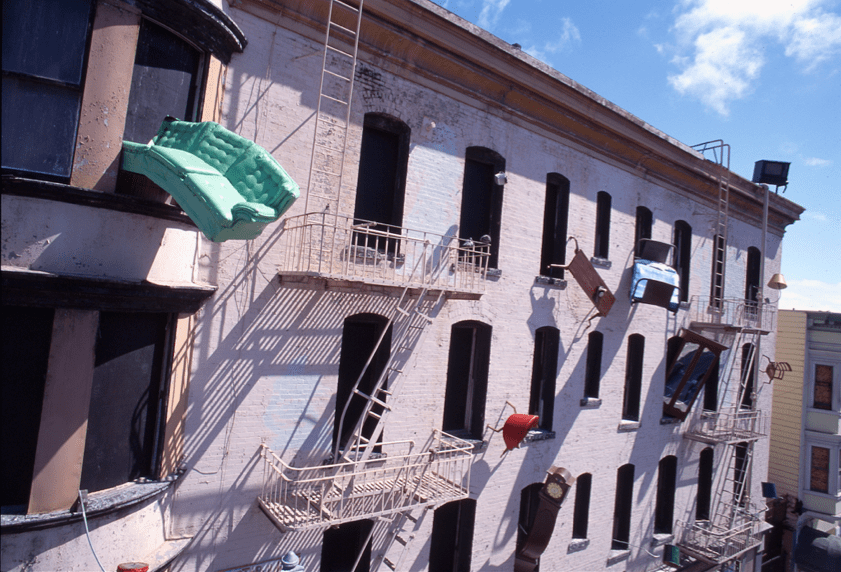
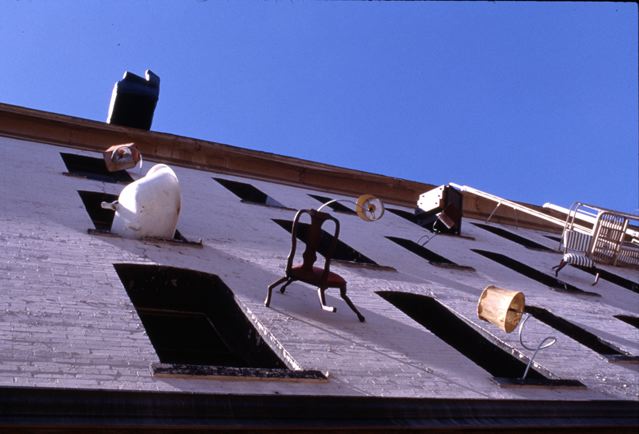

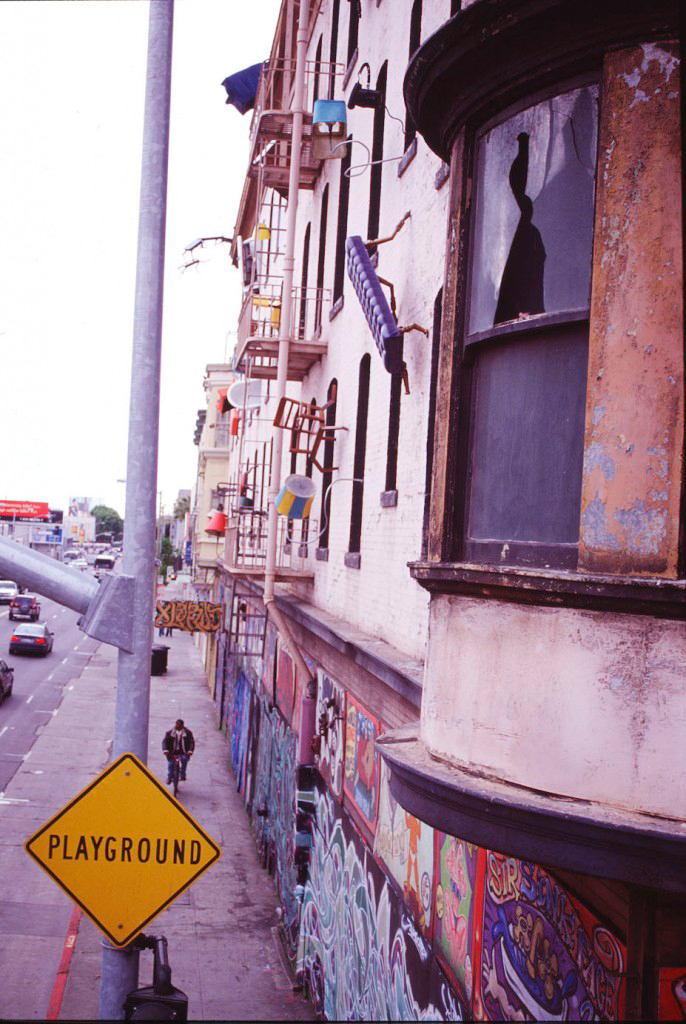
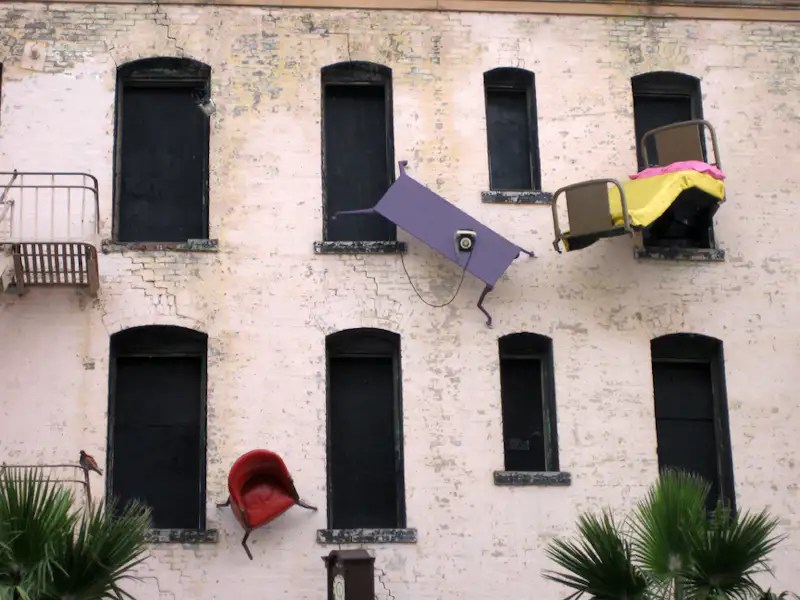
(Site-specific installation on the corner of 6th and Howard St. in San Francisco)
Defenestration as Social Commentary
In an ironic twist that mirrors Goggin’s original vision, the building itself was ultimately demolished in 2014. However, the installation was not mere spectacle; it was an acute social commentary. It breathed new life into “unworthy” objects, turning the act of “throwing out” into a thought-provoking display that invited us to reflect on the lives we share with others, the objects we encounter, and the eery dimensions of the places we inhabit. By capturing the challenges of urban life, given the rising rates of homelessness and social isolation, currently overwhelming California, “Defenestration” still resonates. Even though the structure no longer stands, the installation remains a compelling tribute to both human creativity and the haunting beauty of defying societal norms, particularly in a city as unconventional as San Francisco.
With ‘defenestration,’ the city becomes more than a backdrop; it’s a dynamic stage where anything can happen. This term isn’t just a word; it’s a microcosm of the chaos and order, humanity and the banality of evil, battling in every urban corner.


Sign up for our freshly baked posts
Get the latest culture, movie, and urban life updates sent to your inbox.
Subscribe
Join a bunch of happy subscribers!
 POSTMODERN PROMETHEUS
You must be logged in to post a comment.